
Panoptic Bio is building a transparent and testable forecasting system for clinical development. We publish probabilities before clinical and regulatory outcomes occur, quantify uncertainty, compare models with historical data, experts, and prediction markets, and preserve a permanent record of performance.
The principle is simple. Publish the probability before the answer is known, then measure the result.
The Keytruda question
Keytruda has treated more than 3 million people since its first approval in 2014. There is no credible global estimate of exactly how many lives it has saved, because that would require knowing what would have happened to every patient without treatment. What we do know is that Keytruda has extended survival across many cancers, reduced the risk of death or recurrence, and helped establish immunotherapy as a central part of modern cancer treatment.
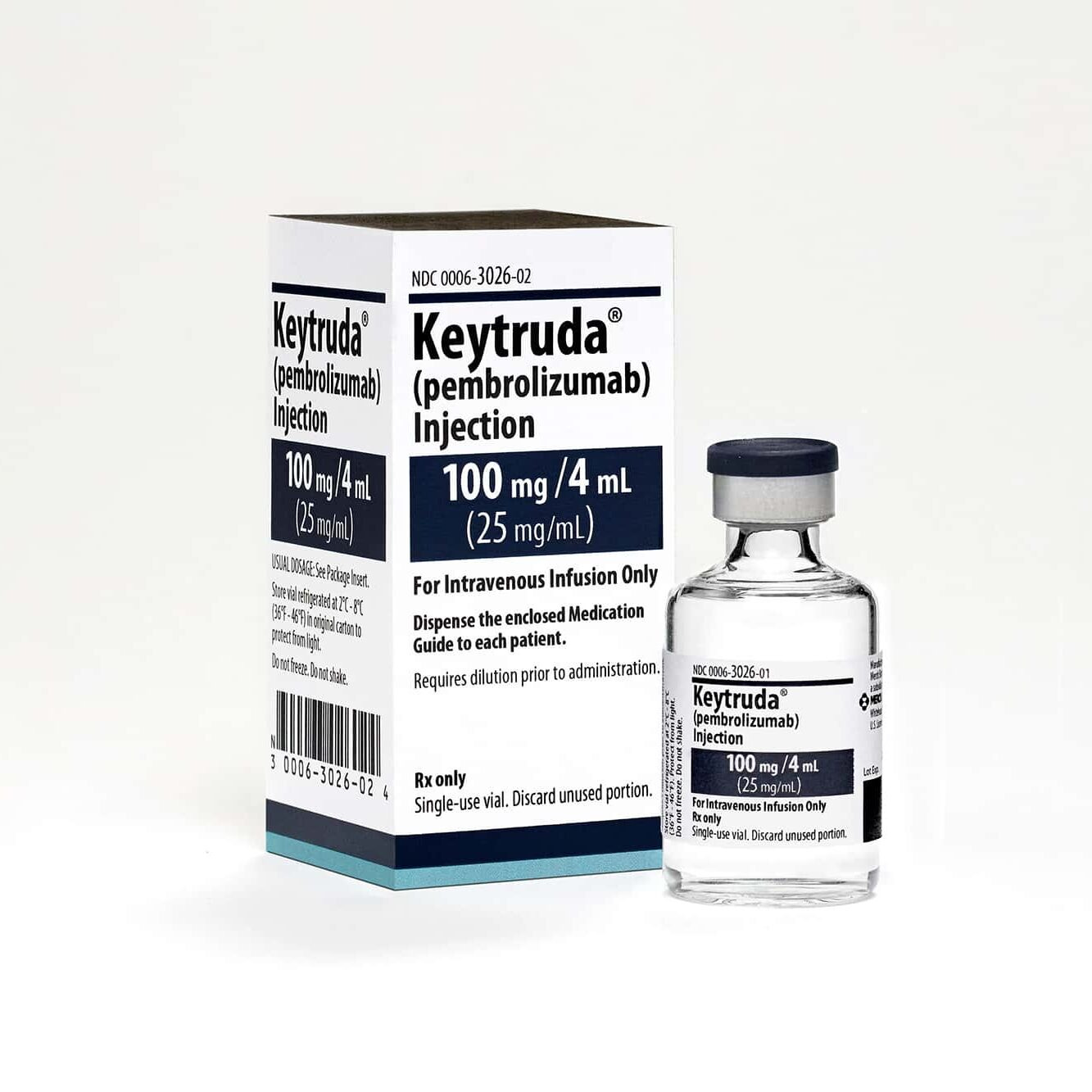
It has also become one of the most commercially successful drugs ever developed. Keytruda generated $31.68 billion in 2025 and approximately $163 billion in cumulative sales between its launch and the end of 2025. It represented nearly half of Merck’s total revenue last year.
Its core US patent cliff begins in 2028. Additional patents, litigation, and new formulations may affect the timing and pace of competition, but the strategic challenge is already clear. Merck must prepare for declining exclusivity around a product that generates almost one out of every two dollars of company revenue.
For the broader industry, the question is just as important:
What becomes the next oncology treatment backbone?
The program we are watching
At Panoptic Bio, we have followed ivonescimab closely because it may help determine whether PD-1 and VEGF bispecifics become a new oncology treatment backbone.
Ivonescimab was developed by Akeso and licensed to Summit Therapeutics in the United States and other major markets. The molecule combines two mechanisms. The first is PD-1 blockade, the same broad immunotherapy pathway targeted by Keytruda. The second is VEGF blockade, which targets tumor blood vessel formation and the tumor microenvironment.
We are watching HARMONi-3 as the strategic test of ivonescimab against Keytruda. Separately, we are publishing our forecast for the pending FDA decision supported by the related HARMONi trial.
These are two different events.
Both trials, along with other active clinical programs, can be followed through the Panoptic Bio Terminal.
HARMONi-3
HARMONi-3 is a global Phase III study comparing ivonescimab plus chemotherapy with Keytruda plus chemotherapy in the first-line treatment of metastatic non-small cell lung cancer.
The squamous and non-squamous populations are being evaluated as separately powered cohorts. The final progression-free survival analysis for the squamous cohort is expected in the second half of 2026. An interim overall survival analysis is also planned.
This is not simply another Phase III oncology study. It is a direct test of whether a PD-1 and VEGF bispecific regimen can outperform a Keytruda-based standard of care in a global patient population.
HARMONi and the pending FDA decision
The current FDA application relates to a separate study, HARMONi, NCT06396065.
HARMONi evaluates ivonescimab plus chemotherapy against placebo plus chemotherapy in patients with EGFR-mutated, non-squamous non-small cell lung cancer. These patients must have experienced disease progression after treatment with a third-generation EGFR tyrosine kinase inhibitor.
The FDA has accepted Summit’s Biologics License Application and assigned a PDUFA action date of November 14, 2026.
The forecasts below apply to this HARMONi-associated FDA approval decision. They do not apply directly to the upcoming HARMONi-3 readout.
The forecast targets are also slightly different. Panoptic Bio’s models estimate the probability of approval based on the clinical development program. The Kalshi contract asks whether the FDA will grant full or accelerated approval before January 1, 2027.
The questions are closely related, but they are not perfectly identical.
How Panoptic Bio analyzed the program
Panoptic Bio uses multiple forecasting methods rather than relying on one model or one qualitative opinion.
Our analysis incorporates public clinical, scientific, regulatory, and molecular information. We enrich that information through our own structured data architecture. Depending on the model, inputs can include trial design, development phase, indication, intervention, mechanism of action, molecular characteristics, sponsor history, development history, comparable programs, and historical phase transitions, among other input variables discussed in our prior posts.

PB-1 and PB-2 were trained and evaluated on historical clinical development outcomes using held-out test sets. Performance was measured through discrimination, calibration, and probability accuracy.
The objective is not merely to classify a program as likely to succeed or fail. The objective is to publish a probability that can be scored after the outcome becomes known.
Forecast record
This forecast was recorded on August 3, 2026. The target is FDA approval of ivonescimab associated with HARMONi.
The model outputs are frozen at publication. Any future changes will be timestamped and preserved rather than overwritten. An outcome label of 1 indicates a positive forecast.
The forecasts will remain public after the FDA decision and will become part of Panoptic Bio’s permanent performance record.
Historical base rates
Historical base rates show what typically happens before considering evidence specific to ivonescimab.
Historical clinical development data suggest a Phase III oncology-to-approval rate of approximately 0.44, a Phase III solid-tumor-to-approval rate of approximately 0.40, and a Phase III immuno-oncology-to-approval rate of approximately 0.48.
Ivonescimab is an immuno-oncology treatment for a solid tumor, so these categories create a broad historical baseline of approximately 0.40 to 0.48.
These numbers are category averages, not forecasts for ivonescimab itself.
The historical approval rate after an oncology NDA or BLA submission is much higher. That is relevant because the ivonescimab application is already under FDA review. However, it answers a later-stage question and is not directly comparable with a forecast made at the beginning of Phase III.
The stage at which a forecast is made matters.
PB-1: Deep Learning model
PB-1 estimates a 0.55 probability of approval, with a confidence interval of 0.53 to 0.57. Its outcome label is 1, positive.
PB-1 is the most conservative Panoptic Bio model. It places greater weight on historical development patterns and trial-level risk. It predicts that approval is more likely than not, but only moderately so. It leaves substantial room for a negative regulatory outcome. This is how the model works.
PB-2: Tabular Foundation Model
PB-2 estimates a 0.68 probability of approval, with a confidence interval of 0.64 to 0.72. Its outcome label is also 1, positive.
PB-2 is more optimistic than PB-1. It identifies stronger positive analogues within the structured tabular data. This is how that model works.
Panoptic Bio’s Clinical Trial Outcome Prediction

At the end of 2025 we introduced Panoptic Bio’s machine learning system for forecasting whether drug programs will successfully transition between clinical development phases.
GPT-5.6 Sol: Public evidence forecast
GPT-5.6 Sol estimates a 0.68 probability of approval, with an uncertainty interval of 0.58 to 0.78. Its outcome label is 1, positive.
This forecast uses publicly available clinical and regulatory evidence. The interval is intentionally wider because it is a judgment-based forecast, not a statistically calibrated confidence interval generated by a clinical development model.
Independent expert review
We also compared the model outputs with a qualitative expert review by senior medical researchers.
The review was directionally positive, but cautious. The experts viewed the progression-free survival evidence and biological rationale as supportive. They also identified meaningful uncertainty around the maturity of overall survival data, consistency across patient populations, and the FDA’s final assessment of benefit and risk.
We did not convert this assessment into a numerical probability because doing so would imply more precision than the review was designed to provide.
The expert comparison captures clinical judgment. It is not intended to imitate a statistical model.
Kalshi prediction market
At the time of the August 3, 2026 snapshot, the Kalshi contract showed a YES bid of 0.64, a YES ask of 0.67, and a bid-ask midpoint of 0.66.
For the main comparison, we use the executable YES ask of 0.67 as the market-implied probability.
The live contract can be followed through the Kalshi ivonescimab market.
What the differences mean
The historical Phase III oncology base rate is 0.44. PB-1 estimates 0.55. PB-2 estimates 0.68. GPT-5.6 Sol also estimates 0.68. The independent expert review is positive, with meaningful uncertainty. Kalshi’s YES ask is 0.67.
Every case-specific method currently leans positive, but the level of confidence varies.
PB-1 is only moderately above the historical oncology base rate. PB-2 is more optimistic. GPT is closely aligned with PB-2, and both are close to the prediction market. The expert review points in the same direction, but avoids false numerical precision.
The disagreement is the useful part.
Different methods use different evidence, make different assumptions, and represent clinical development in different ways. A single probability can hide those differences. Comparing models, historical data, experts, and markets makes them visible.
No forecast suggests that approval is certain. Even a probability of 0.68 leaves a 0.32 probability of a negative outcome.
The real test
One correct forecast would not validate Panoptic Bio. One incorrect forecast would not invalidate it.
The real test is performance across a large portfolio of timestamped predictions.
Panoptic Bio will evaluate forecasts through calibration, discrimination, and probability scoring. We will not rely on retrospective narratives about why a model was supposedly right.
Clinical trial forecasting should be explicit, testable, and accountable.
The important question is not who can produce the best explanation after the result is announced.
It is who is willing to publish a probability before the outcome and preserve the record after it becomes known.
Disclaimer
Panoptic Bio is an independent artificial intelligence company. This publication is based solely on public information and does not constitute investment, medical, legal, regulatory, or financial advice.
Panoptic Bio is not affiliated with, endorsed by, or authorized to speak for any company, institution, regulator, market, or individual mentioned. All forecasts are probabilistic estimates, not guarantees. Information may be incomplete or inaccurate, and readers should conduct their own diligence before making decisions.