
At the end of 2025 we introduced Panoptic Bio’s machine learning system for forecasting whether drug programs will successfully transition between clinical development phases.
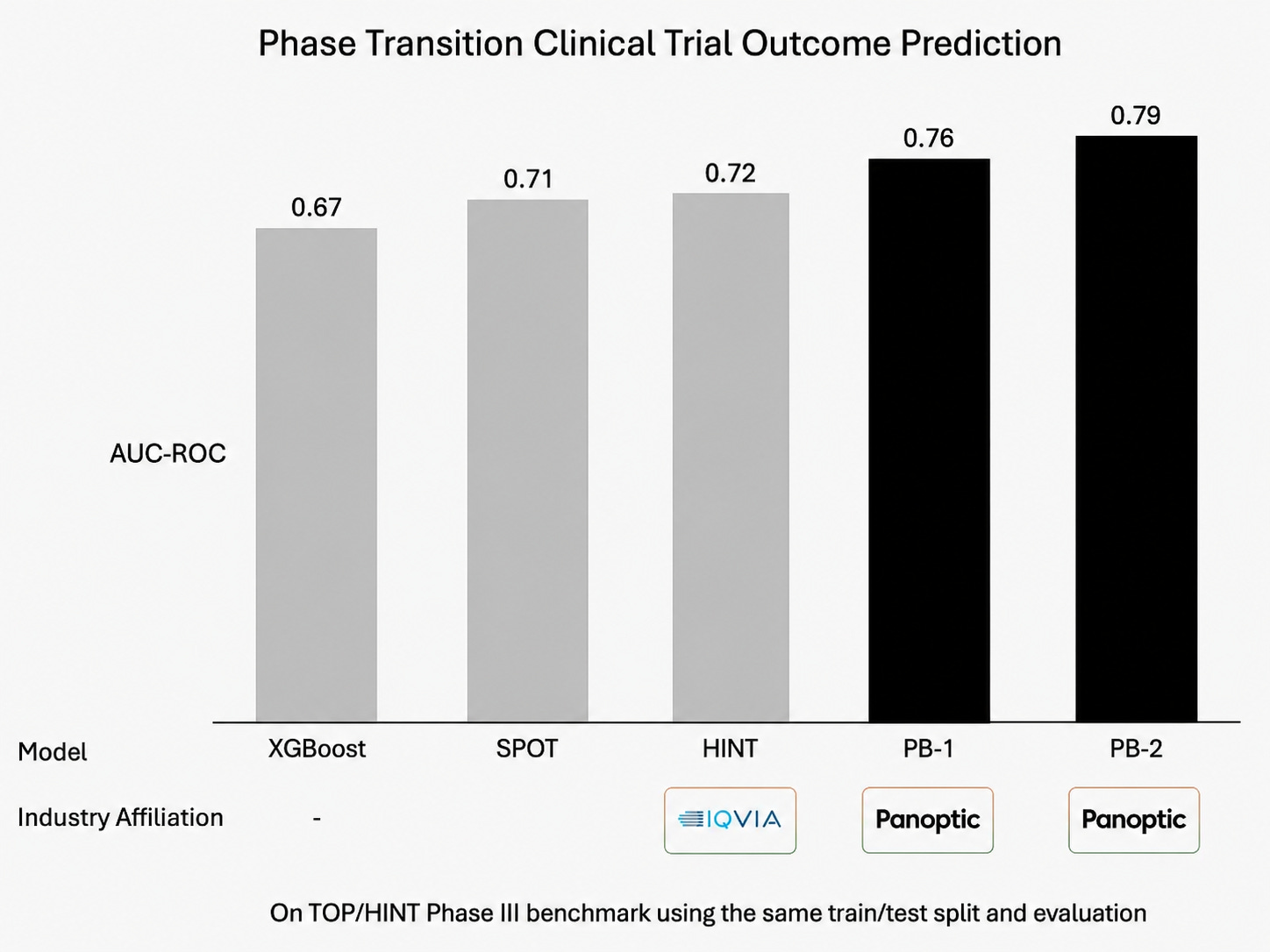
Our earlier Panoptic Bio PB-1 model achieved a 0.76 ROC-AUC for Phase III outcome prediction on the HINT benchmark.
We have now developed a new model, PB-2, using a tabular foundation model combined with Panoptic Bio’s proprietary autoresearch framework. On the same Phase III test set, the new model achieved:
ROC-AUC: 0.7928
PR-AUC: 0.8806
F1 score: 0.8406
Recall: 0.9259
This represents an improvement in ROC-AUC from 0.76 to 0.7928, while maintaining high recall and delivering strong precision-recall performance.
Why Tabular Foundation Models?
Clinical trial outcome prediction is fundamentally a structured-data problem. Each program can be represented through features describing the drug, disease, sponsor, trial design, development history, endpoints, and other characteristics known before the outcome occurs.
Tabular foundation models are designed specifically for tabular data. Rather than relying only on patterns learned from one training dataset, it uses prior learning from a broad range of simulated tabular problems to make predictions on new datasets.
For clinical development, this provides a promising approach for identifying complex relationships across relatively small, specialized datasets.
Life sciences decision making
Panoptic Bio’s objective is not simply to label a trial as a success or failure.
Our models produce calibrated probabilities that can support:
Clinical trial outcome forecasting
Phase-transition and duration forecasting
Risk-adjusted valuation
Licensing and M&A diligence
Portfolio construction
Capital-allocation decisions
For example, a change in the predicted probability of Phase III success can materially change the risk-adjusted value of a clinical-stage asset.
Panoptic Bio’s PB-2 with tabular foundation model improved ROC-AUC from 0.76 to 0.7928 and achieved an F1 score of 0.8406.
What comes next
We are continuing to improve the system through temporal validation, therapeutic-area-specific testing, calibration analysis, uncertainty estimation, and prospective prediction of trials whose outcomes are not yet known.
The goal is to build increasingly reliable models for forecasting clinical development outcomes and translating those predictions into better decisions across drug development, licensing, valuation, and portfolio strategy.
Application
On www.panoptic.bio, you can now:
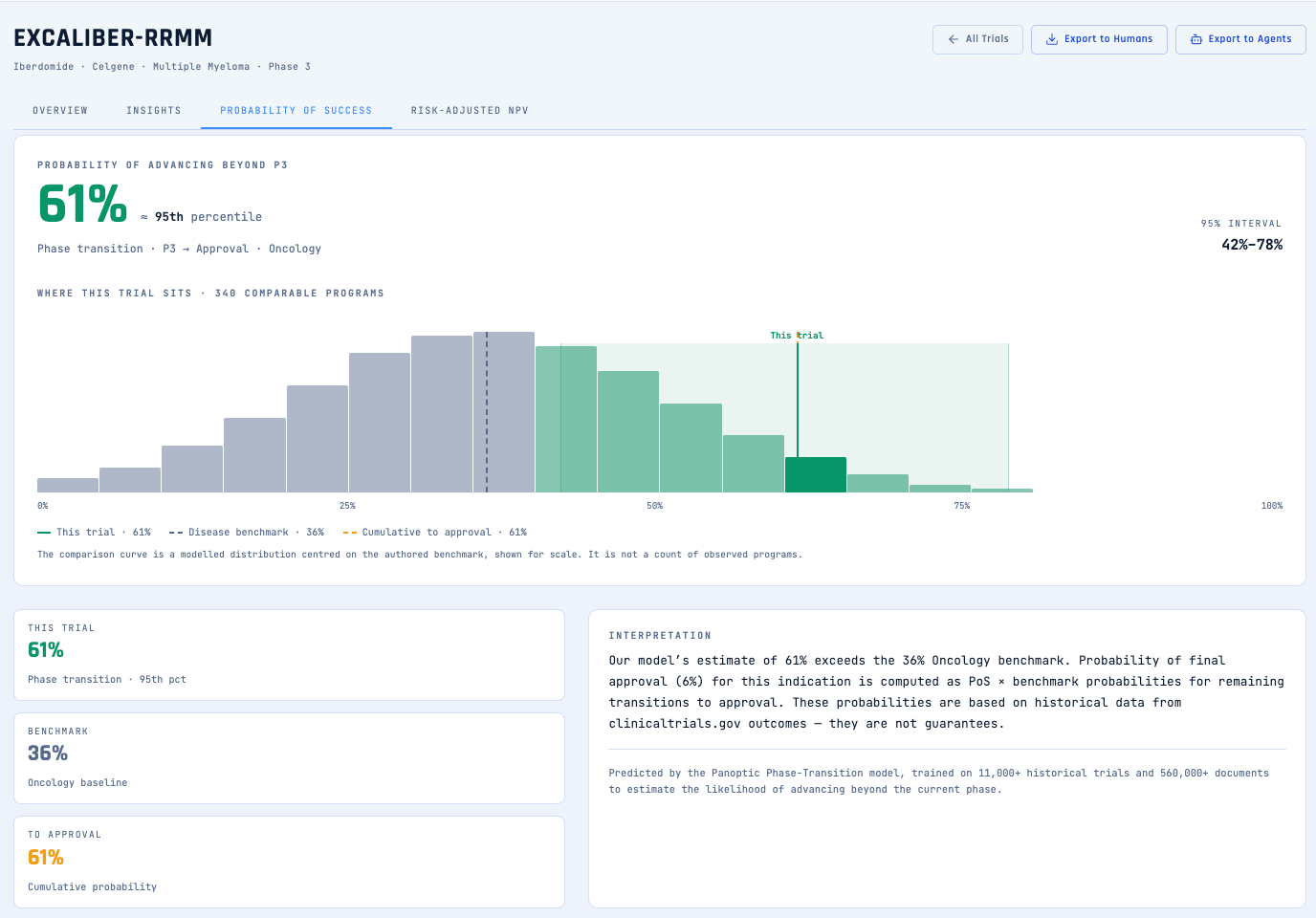
Compute the probability of success for ongoing clinical trials:
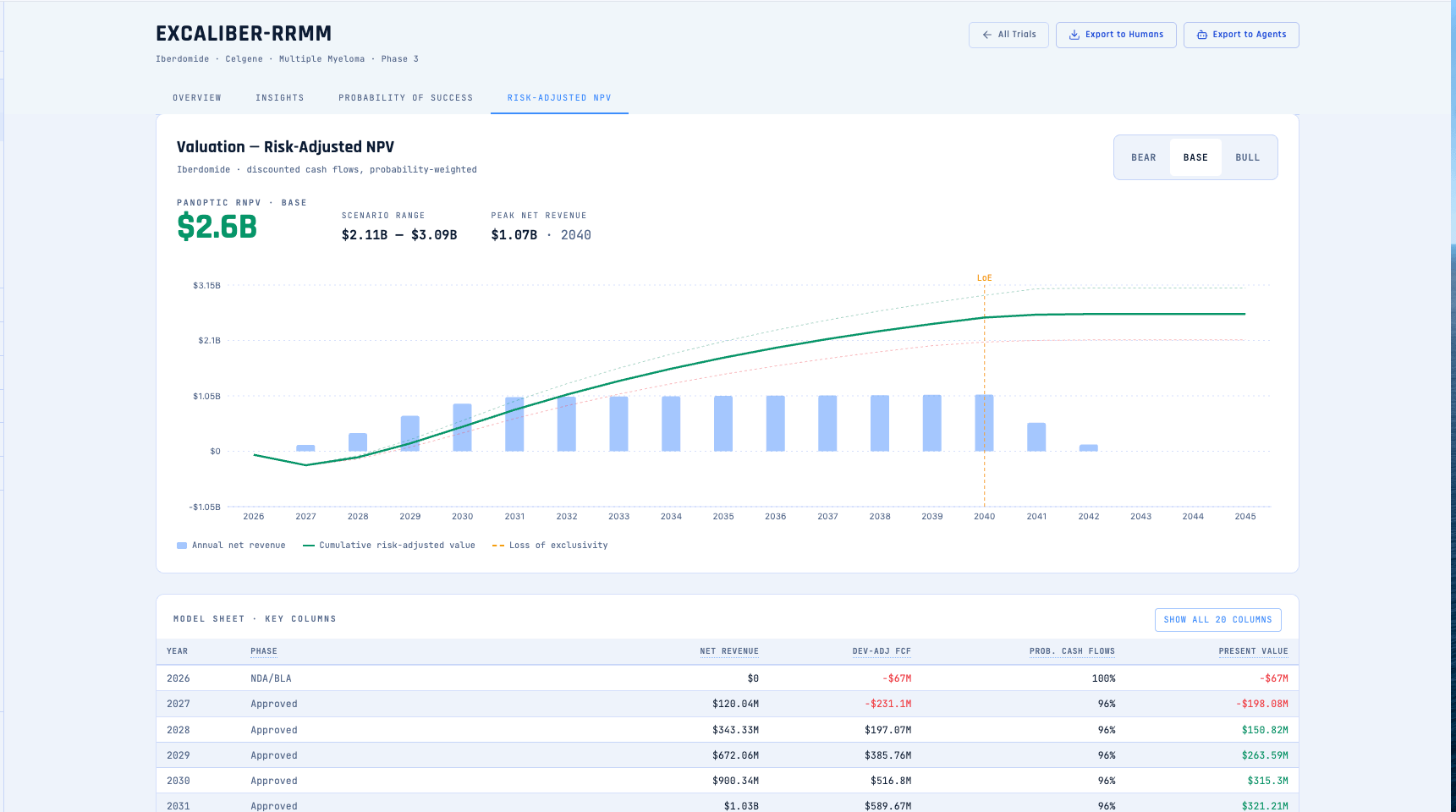
Compute the valuation and risk-adjusted Net Present Value (NPV) for ongoing clinical trials
This model and application gives the life sciences industry a unified way to identify emerging innovation, anticipate critical clinical and regulatory events, quantify development risk, and allocate capital toward the programs most likely to succeed. For patients, this can help promising therapies reach the right trials faster, improve visibility into upcoming treatment options, and support better decisions about which programs advance toward approval and make patients healthier.