
In 2002, aerospace was dominated by giant incumbents. Boeing was market leader, founded in 1916. It had scale, contracts, and trust. And yet, the aerospace launch industry was highly inefficient.
Expensive. Slow. And failure was the norm. The industry had optimized itself around massive programs, complex handoffs, long development cycles, and no room for fast iteration.
SpaceX was founded in 2002. Not as another supplier, better consultant, or marginally cheaper contractor. Instead, SpaceX rebuilt the launch system itself around success.
It questioned the requirements. It deleted unnecessary complexity. SpaceX’s breakthrough was making rockets reusable and repeatable. Launch, land, inspect, and relaunch. Turning spaceflight from a one-time event into a repeatable system that dramatically improved success, speed, and cost. SpaceX learned by launching, failing, relaunching, and improving. And over time, the company turned one of the most expensive, slow-moving engineering domains in the world into something repeatable.
The equivalent breakthrough in pharma would be turning drug development from isolated, mostly failed experiments into a repeatable learning system where every trial improves the odds that the next drug successfully reaches patients.

Pharma in 2026 is much like Aerospace in 2002.
Eli Lilly is the Boeing of today. The market leader, with a market cap of roughly $1T. Founded in 1876, with over 50,000 employees, it is a legacy player.
The world is spending more than ever on pharmaceuticals and pharmaceutical R&D. The industry is enormous. The science extraordinary. And the need is obvious.
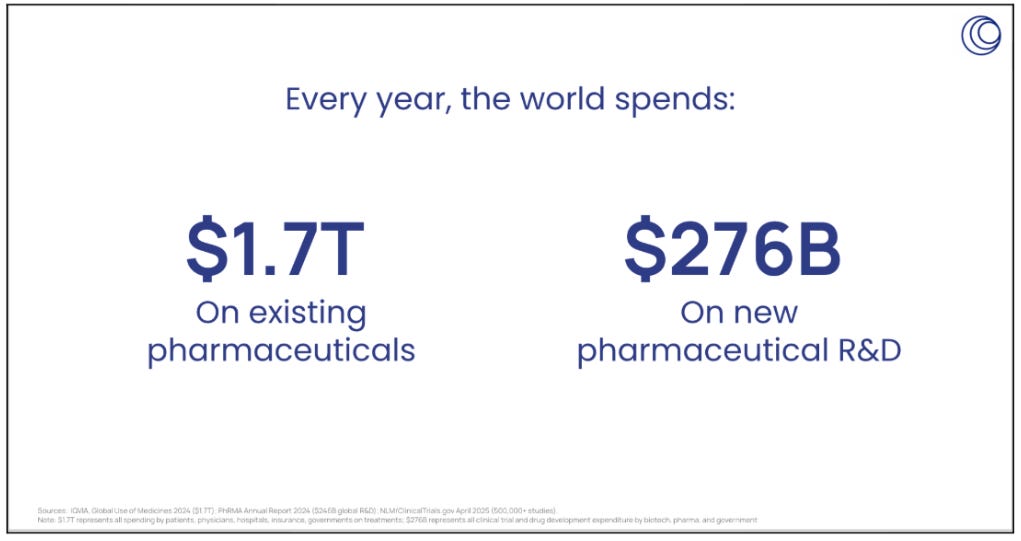
And yet, the system underneath is deeply inefficient.
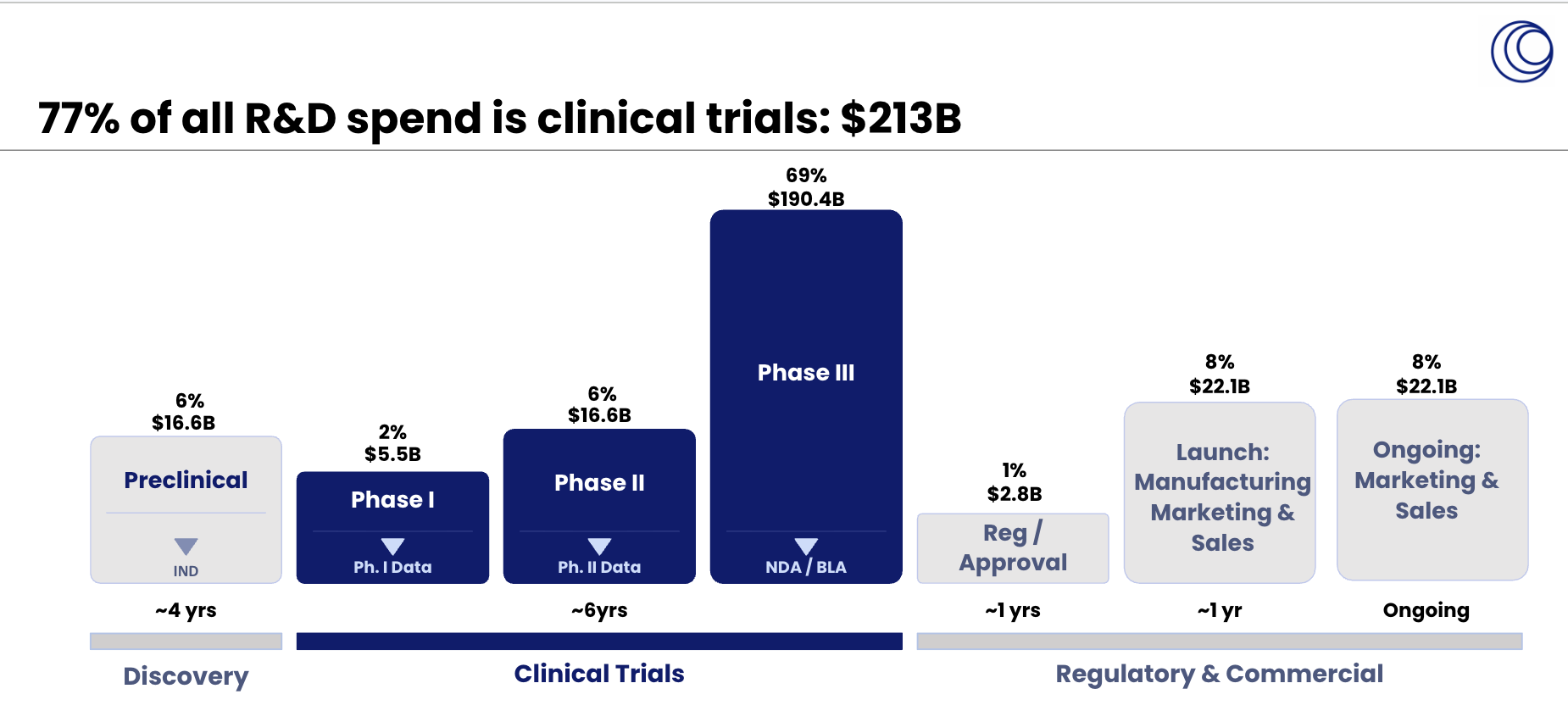
The industry often behaves as if the main problem is in drug discovery. Discovery gets most of the attention because it is exciting. It is visual. It is computational. It is where foundation models, generative chemistry, target discovery, and biological data platforms naturally cluster.
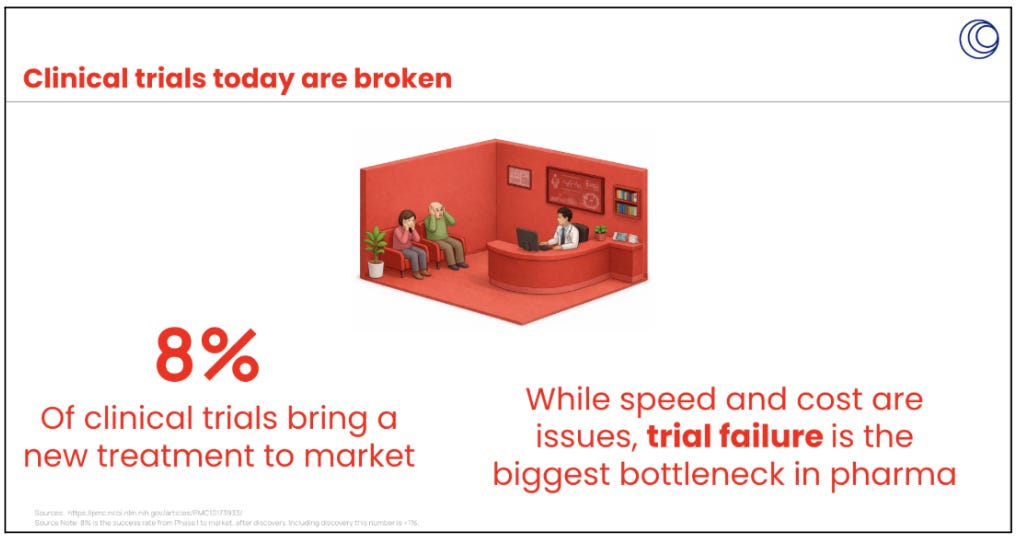
The brutal reality is that only a small percentage of clinical trials bring a new treatment to market.
The industry is filled with brilliant scientists, clinicians, operators, investors, and executives. But the decision-making infrastructure around clinical development remains fragmented.
Biology lives in one place. Clinical trial data lives somewhere else. Regulatory precedent is scattered. Commercial context is often downstream. Competitive intelligence is manually assembled. Financial assumptions are rebuilt in spreadsheets. Analyst judgment lives in decks, notes, calls, and memory.
The result is that the most important decisions in the industry are still made through a messy combination of expert intuition, incomplete evidence, manual synthesis, and institutional pattern recognition. That is not good enough for a trillion-dollar industry. Especially not an industry where the cost of being wrong is measured in years, billions of dollars, and hundreds of thousands of patients waiting for better treatments.
The wrong optimization
For years, pharma has focused on speed and cost. Faster discovery. Cheaper trials. More automation. Resulting in more molecules, targets, screens, dashboards, and summaries. All of that matters. But it misses the central problem: You cannot optimize a system that is not successful.
Elon Musk’s engineering framework is simple:
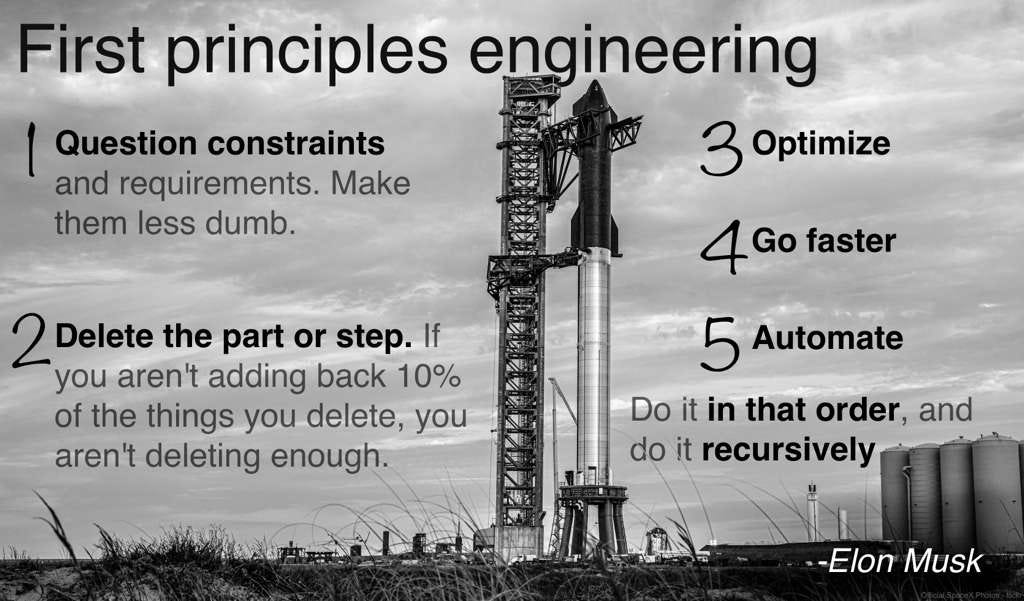
The order matters. Acceleration and automation are steps 4 and 5; they come last.
Pharma has mostly done the opposite. Starting with automation. AI is being layered on top of broken workflows. More software is being added to processes that may not deserve to exist. More dashboards are being built for decisions that still lack the right underlying intelligence. That is why so many AI tools in pharma feel useful but not transformative. They make the existing system easier to operate.
But SpaceX did not win by making PowerPoints for Boeing. It won by rebuilding the launch system. That is what pharma needs. Not another tool around the edges. Not another workflow product. Not another chatbot on fragmented data.
Pharma needs a repeatable launch and relaunch system for drug development. Right now, the industry has an 8% success rate. It is not ripe for automation. It is ripe for questioning constraints, deleting what should not exist, and optimizing for success rate. A faster failed trial is still a failed trial. A cheaper failed trial is still a failed trial. An automated failed trial is still a failed trial. The glaring error is success rate. And therefore, the glaring opportunity is success rate. The future is in clinical.
The SpaceX of pharma
The lesson of SpaceX is not “move fast.” That is the shallow reading.
The deeper lesson is that old industries are not transformed by optimizing individual pieces of a broken system. They are transformed when someone rebuilds the system around a better operating model. SpaceX did not merely make rockets cheaper. It created a launch and relaunch machine.
Pharma needs the same thing: A repeat-success machine.
This is what the pharma company of the future looks like:
The floors are arranged in the order of the optimal drug development lifecycle for the AI era. The top floor of this pharma company is the brain. A decision making AI that understands risk, evidence, biology, regulation, competition, and value. It is a system where every trial makes the next trial smarter. A system where every failure teaches the model. A system where evidence compounds.The next floor is a data and computation center, because data and compute are the new assets of pharma, not just bench scientists. The next floor is a discovery lab, where fundamental and translational science occurs. The next floor is for in-human clinical testing. The next floor is for biomanufacturing. And the ground floor is for shipping. This pharma company is all connected. All learning. All oriented around one goal: increasing the probability that important medicines actually reach patients.
This year is the year the SpaceX of pharma is being founded
It will not look like a traditional pharma company at first. It may not even look like a pharma company at all. It will start as infrastructure. It will start as software. It will start as a terminal for better decisions.
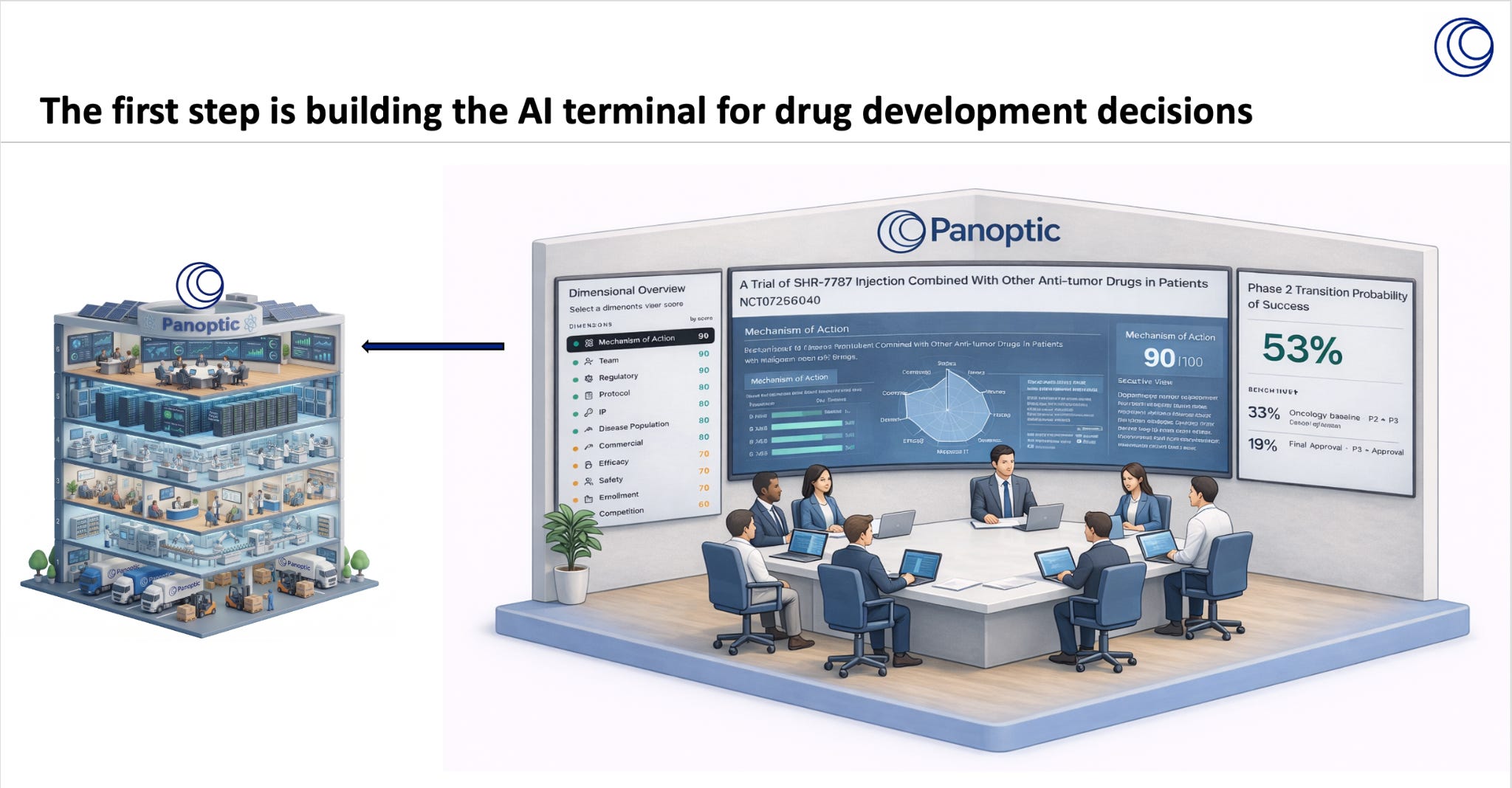
Before the rocket lands, there is a control room. That is how these transformations often begin. Before the company changes the industry, it changes how the industry makes decisions. Pharma does not need another chatbot. It needs its SpaceX. A company that can launch and re-launch drugs to patients like rockets to the moon.
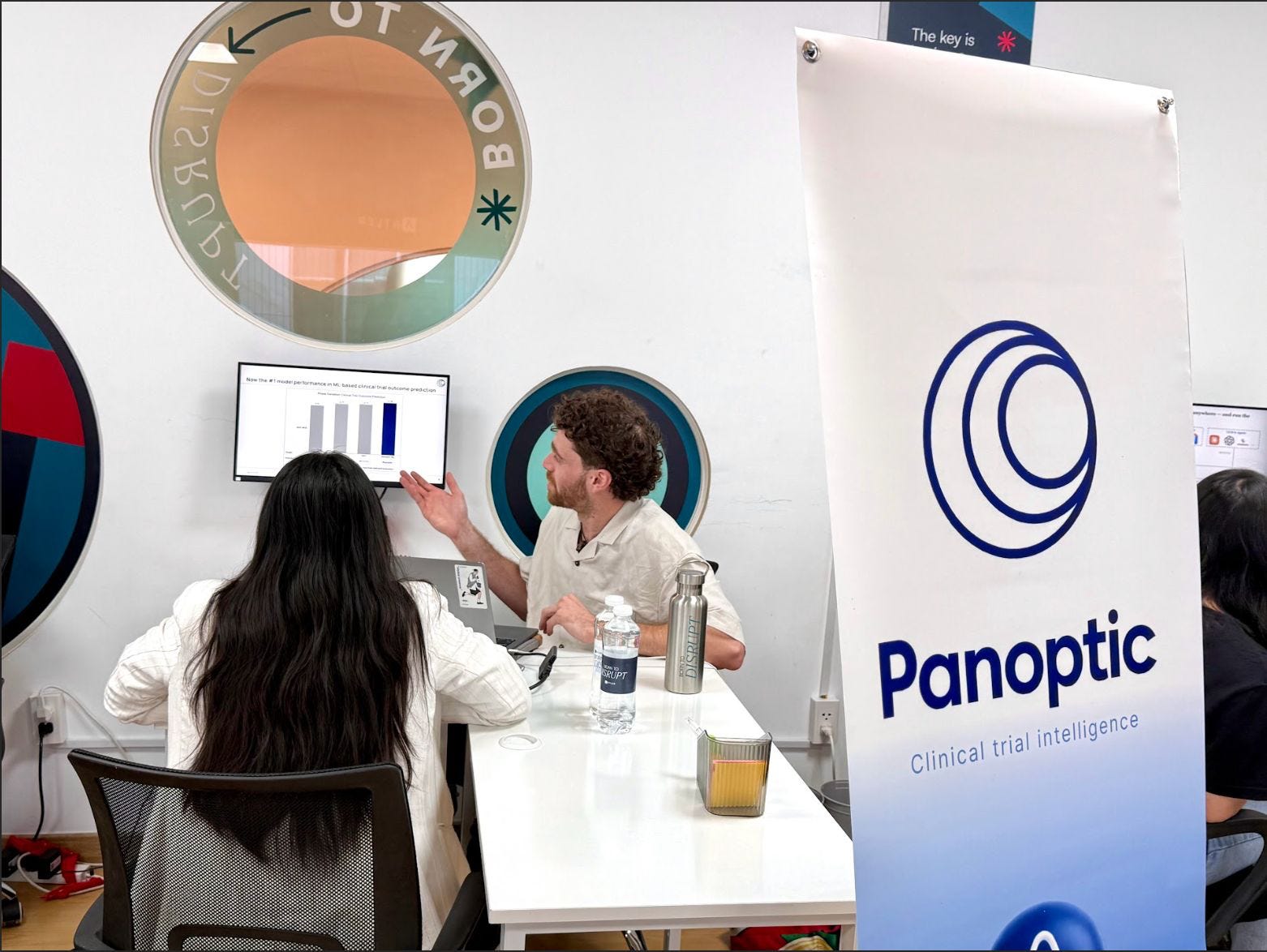
Panoptic Bio team member showing results of the top ranking benchmark in clinical trial outcome prediction.
Pharma Disruption starts in 2026
The old aerospace industry was a maze of suppliers, contractors, consultants, and middlemen. Everyone got paid. Not everyone learned. Pharma is fragmented the same way. The winner won’t be the company that outsources development most efficiently. It will be the company that captures and compounds every lesson from every trial.

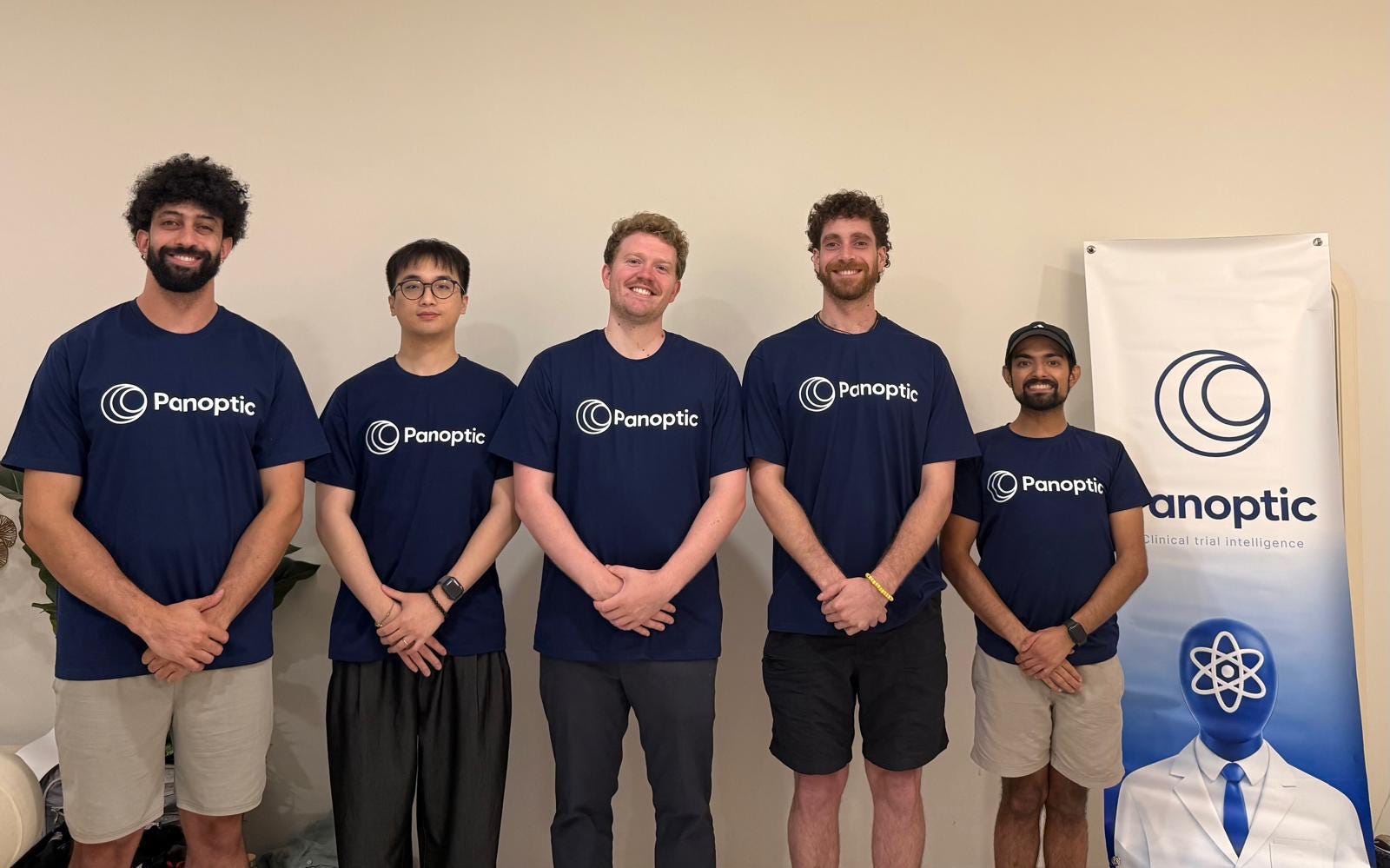
History is usually changed by small teams willing to take on impossibly large problems.
Sources:
Clinical Development Success Rates and Contributing Factors 2011-2020
https://go.bio.org/rs/490-EHZ-999/images/ClinicalDevelopmentSuccessRates2011_2020.pdf
Dynamic clinical trial success rates for drugs in the 21st century
https://www.nature.com/articles/s41467-025-64552-2
Global R&D Trends 2026 https://www.iqvia.com/insights/the-iqvia-institute/reports-and-publications/reports/global-r-and-d-trends-2026
Measuring the return from pharmaceutical innovation 2024 https://www.deloitte.com/ch/en/Industries/life-sciences-health-care/analysis/measuring-the-return-from-pharmaceutical-innovation.html
Making more medicines that matter: A new recipe for biopharmaceutical R&D https://www.mckinsey.com/industries/life-sciences/our-insights/making-more-medicines-that-matter
Innovation in the pharmaceutical industry: New estimates of R&D costs
https://www.sciencedirect.com/science/article/abs/pii/S0167629616000291
Artificial intelligence in drug development
https://www.nature.com/articles/s41591-024-03434-4
How successful are AI-discovered drugs in clinical trials? A first analysis and emerging lessons
https://www.sciencedirect.com/science/article/pii/S135964462400134X
Digital in R&D: The $100 billion opportunity
https://www.mckinsey.de/~/media/McKinsey/Industries/Pharmaceuticals%20and%20Medical%20Products/Our%20Insights/Digital%20in%20R%20and%20D%20The%20100%20billion%20opportunity/Digital-in-R-and-D-The-100-billion-opportunity.pdf
Watch SpaceX’s reused Falcon 9 rocket nail its landing
https://www.wired.com/story/spacex-launch-watch-reuse-rocket/
www.panoptic.bio